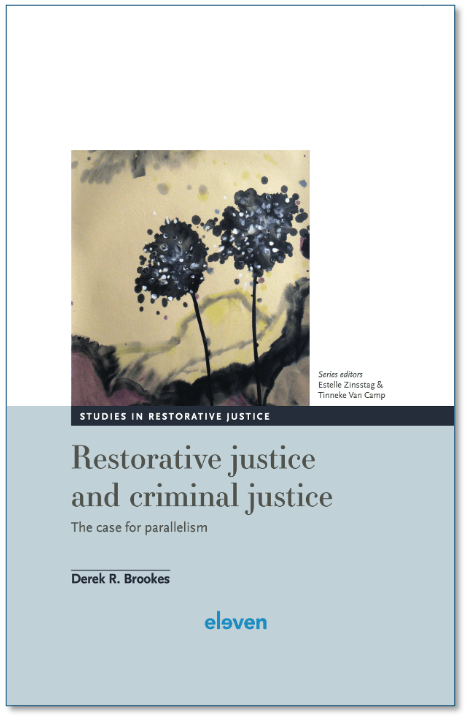
Restorative justice and criminal justice: The case for parallelism
Purchase | Print Sample (pdf 1 MB)
Abstract
Criminal justice is primarily designed to serve the public interest in relation to criminal acts. Restorative justice is designed to address the harm-related needs of individuals in the aftermath of wrongdoing. These distinct aims require such different processes and priorities that any attempt to integrate restorative justice within the criminal justice system will almost invariably undermine the quality and effectiveness of both. In this book, the author argues that the optimal relationship between the two should therefore be one of maximum independence: the instruments of the state should not be used to impose or enforce the decision to participate in restorative justice, any component of the restorative justice process or its outcome. It is also suggested that, in the absence of legislative innovation, this kind of separation is likely to require that restorative justice is situated after a case has actually exited the justice system, or after it has, in legal terms, effectively done so, as in a post-sentence context. [Note: The publisher offers a 40% discount on this book (conditions apply)].
Beyond Harm: Toward Justice, Healing and Peace
Purchase | Print Sample (pdf 4.5 MB) | Audio Sample (5 mins)
Abstract
This book looks at what it means to be wronged, and why we react to wrongdoing in ways that can cause us more suffering and pain. An alternative approach called ‘restorative justice’ is proposed as a safe and effective way of avoiding these reactions whilst honouring our values and our common humanity.
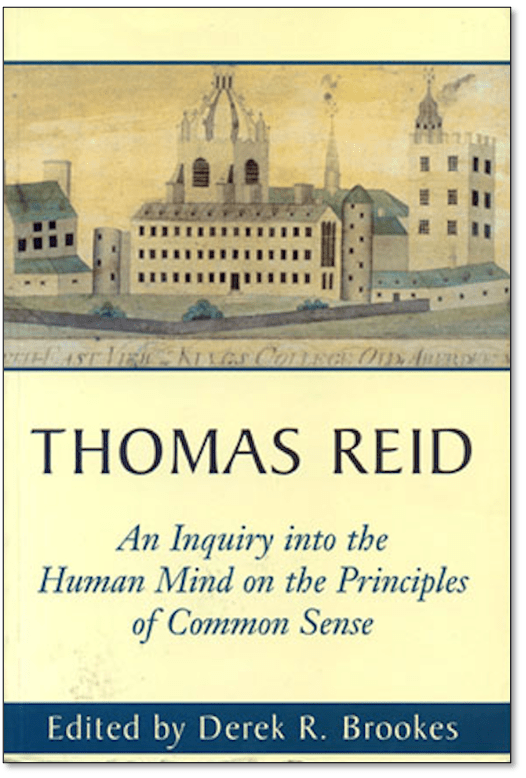
Abstract
Thomas Reid (1710–96) is increasingly being seen as a highly significant philosopher and a central figure in the Scottish Enlightenment. This new edition of Reid’s classic philosophical text in the philosophy of mind at long last gives scholars a complete, critically edited text of the Inquiry. The critical text is based on the fourth life-time edition (1785). A selection of related documents showing the development of Reid’s thought, textual notes, bibliographical details of previous editions and a full introduction by the editor makes this an important contribution to the study of this increasingly respected philosopher.
Thomas Reid: Essays on the Intellectual Power of Man: A Critical Edition
Abstract
This is Thomas Reid’s greatest work. It covers far more philosophical ground than the earlier, more popular Inquiry. The Intellectual Powers and its companion volume, Essays on the Active Powers of Man, constitute the fullest, most original presentation of the philosophy of Common Sense. This is the only properly established text. It is accompanied by manuscript lectures on the nature and immortality of the soul, as well as helpful editorial annotation and introduction, making it useful to a wide variety of readers.
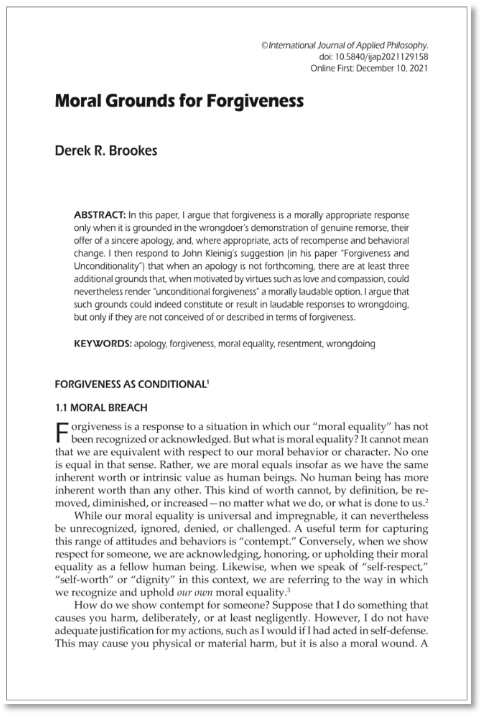
Moral Grounds for Forgiveness.
International Journal of Applied Philosophy 35 (1): 97-108.
Download (pdf 5.3 MB)
Abstract
In this paper, I argue that forgiveness is a morally appropriate response only when it is grounded in the wrongdoer’s demonstration of genuine remorse, their offer of a sincere apology, and, where appropriate, acts of recompense and behavioral change. I then respond to John Kleinig’s suggestion (in his paper “Forgiveness and Unconditionality”) that when an apology is not forthcoming, there are at least three additional grounds that, when motivated by virtues such as love and compassion, could nevertheless render “unconditional forgiveness” a morally laudable option. I argue that such grounds could indeed constitute or result in laudable responses to wrongdoing, but only if they are not conceived of or described in terms of forgiveness.
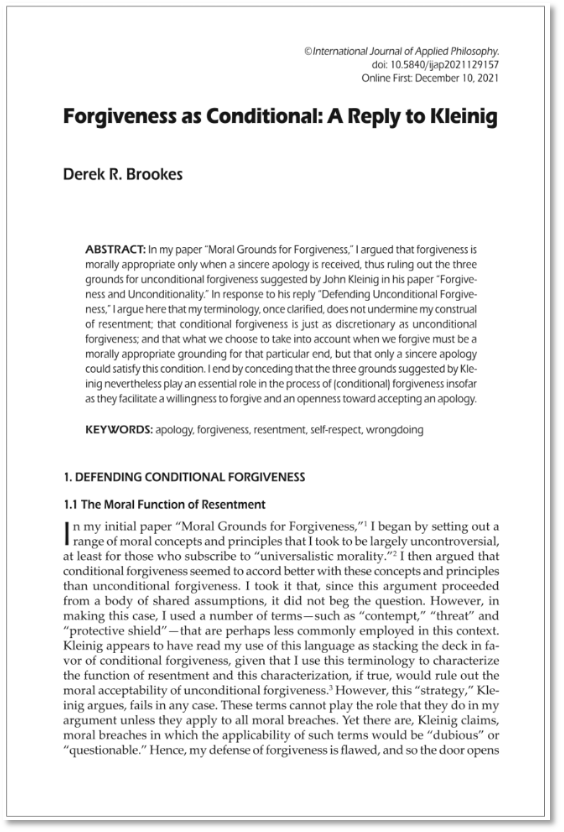
Forgiveness as Conditional: A Reply to Kleinig.
International Journal of Applied Philosophy 35 (1): 117-125.
Download (pdf 126 KB)
Abstract
In my paper “Moral Grounds for Forgiveness,” I argued that forgiveness is morally appropriate only when a sincere apology is received, thus ruling out the three grounds for unconditional forgiveness suggested by John Kleinig in his paper “Forgiveness and Unconditionality.” In response to his reply “Defending Unconditional Forgiveness,” I argue here that my terminology, once clarified, does not undermine my construal of resentment; that conditional forgiveness is just as discretionary as unconditional forgiveness; and that what we choose to take into account when we forgive must be a morally appropriate grounding for that particular end, but that only a sincere apology could satisfy this condition. I end by conceding that the three grounds suggested by Kleinig nevertheless play an essential role in the process of (conditional) forgiveness insofar as they facilitate a willingness to forgive and an openness toward accepting an apology.
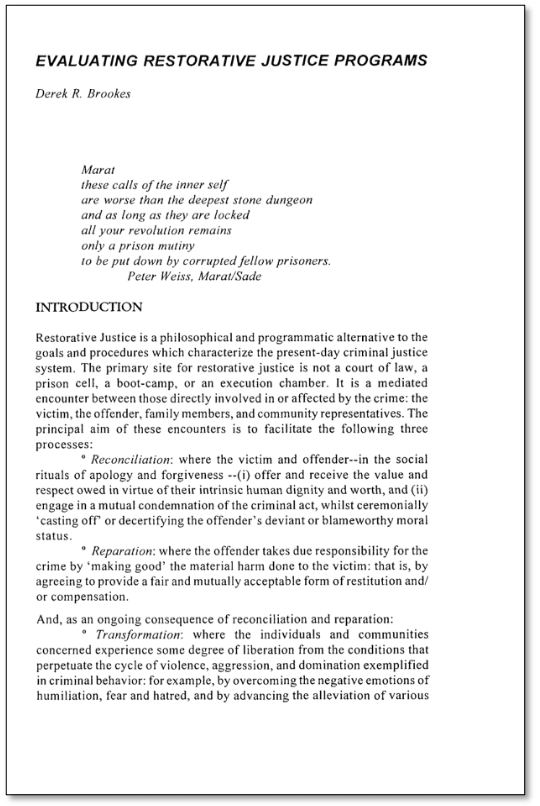
Evaluating Restorative Justice Programs.
Humanity and Society 22 (I): 23-37.
Download (pdf 890 KB)
Abstract
The human dimensions involved in the operational objectives of Restorative Justice demand the highest quality of program design and staff training. In this paper, I argue that this desideratum has yet to be fully realised in existing Restorative Justice programs, in particular, with regard to the facilitation of reconciliation. I begin by presenting the chief problems associated with the concentration on reparation in Restorative Justice programs, to the neglect of reconciliation. I then argue that this phenomenon is, in part, a consequence of (i) the almost universal use of service-delivery criteria in the evaluation of Restorative Justice programs, and (ii) the absence of research on the interactional processes involved within the victim-offender encounter itself, using suitably designed methodological tools.

The Possibility of a Correctional Ethic.
In J. Kleinig and M. L. Smith (ed.), Discretion, Community, and Correctional Ethics (pp. 39-68). Lanham, MA: Rowman & Littlefield.
Download (pdf 1.9 MB)
Abstract
In this article, I argue that the kind of suffering that prisons impose upon people who are incarcerated disregards their uniqueness and fails to meet their basic needs in a manner which violates their dignity and worth as human beings. Hence, the prison, as an institution, cannot be morally justified. But since the imposition of this kind of suffering is an integral element of a prison’s central function, it follows that a ‘Correctional Ethic’ is effectively an oxymoron, not dissimilar to an ‘Ethic for Slave-masters’.
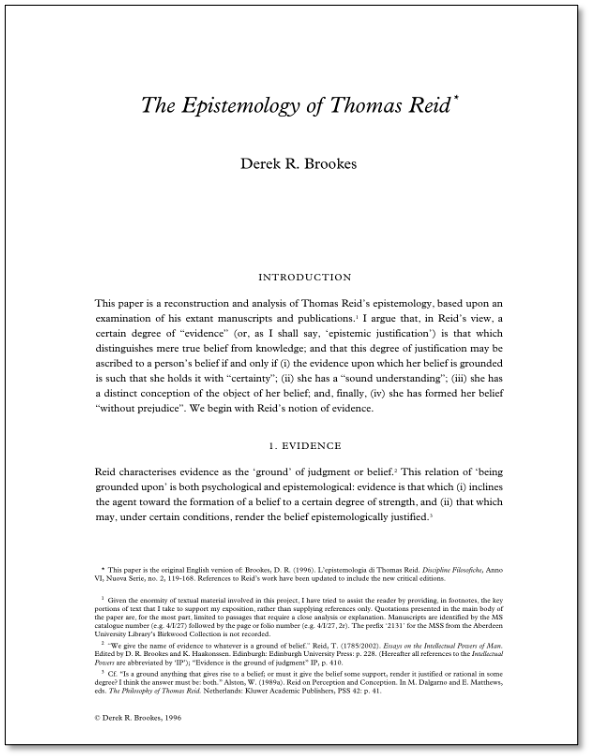
Abstract
This paper is a reconstruction and analysis of Thomas Reid’s epistemology, based upon an examination of his extant manuscripts and publications. I argue that, in Reid’s view, a certain degree of “evidence” (or, as I shall say, ‘epistemic justification’) is that which distinguishes mere true belief from knowledge; and that this degree of justification may be ascribed to a person’s belief if and only if (i) the evidence upon which her belief is grounded is such that she holds it with “certainty”; (ii) she has a “sound understanding”; (iii) she has a distinct conception of the object of her belief; and, finally, (iv) she has formed her belief “without prejudice”.

